- Published on
Nested Cluster Methods for Portfolio Construction
Nested cluster optimization reduces a large allocation problem into within-cluster and between-cluster steps. The notebooks examine conditioning, denoising, exposure constraints, and the resulting allocation error.
The central relation
Covariance sensitivity is summarized by the spectral condition number
is a positive-definite covariance matrix. Its largest and smallest eigenvalues are and . A large ratio indicates that inversion can magnify small input changes.
Building portfolios through nested clusters
The weight plot separates within-cluster allocations from the final portfolio. The rolling public comparison shows how NCO behaves beside benchmark methods.
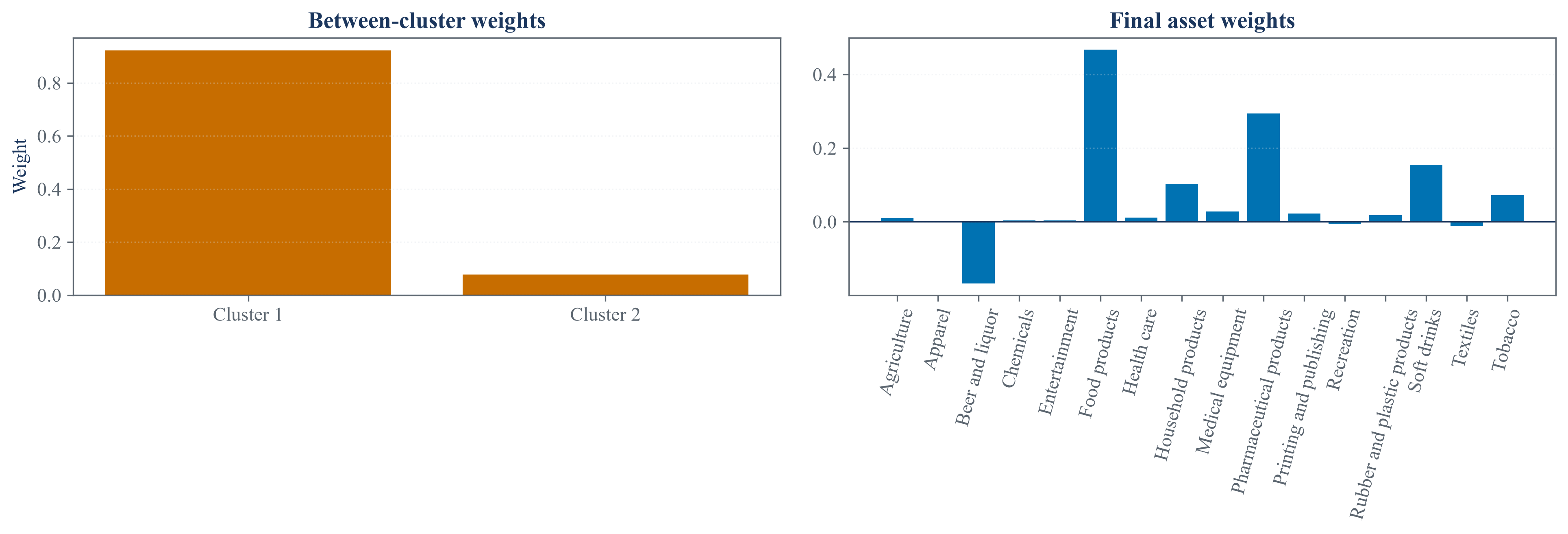
The final allocation combines a decision inside each cluster with a second decision across cluster portfolios.
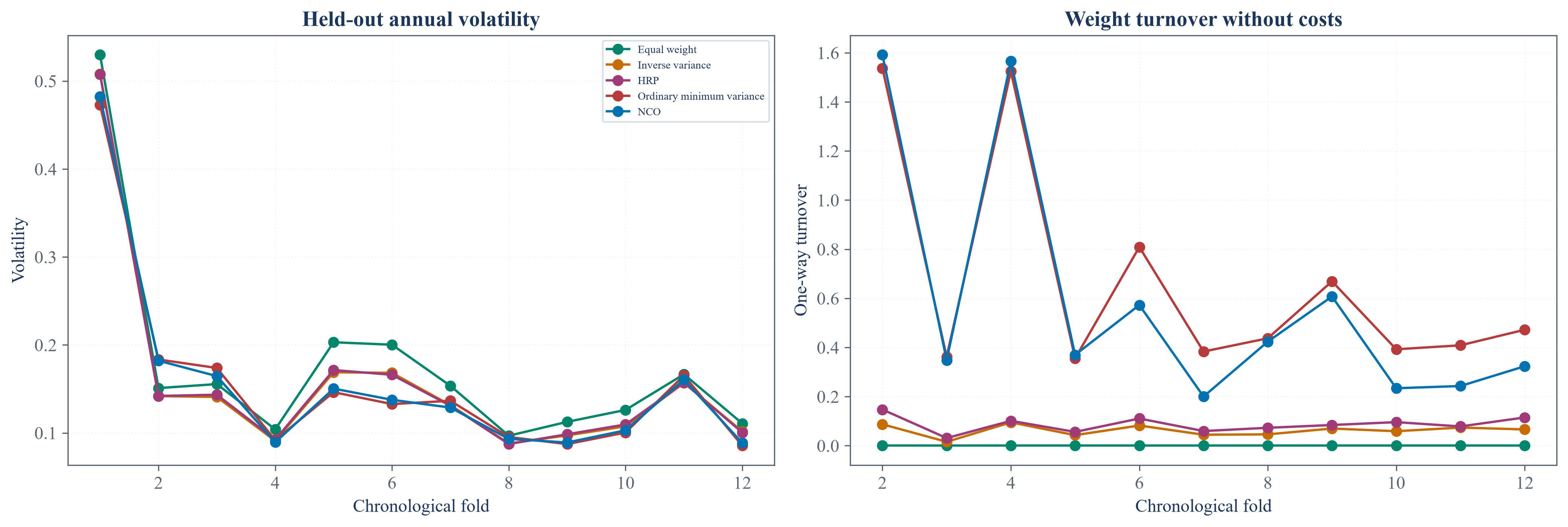
The rolling result evaluates allocations fitted on earlier returns and reports their later risk and stability on common windows.
Breaking the problem into clusters can reduce estimation error, but it also makes the clustering rule and cluster stability part of the portfolio result.
Notebooks
| 1. Optimizing within clusters before combining them |
| 2. Nested Clustered Optimization under Estimation Error |
| 3. Building a constrained hedge |