Hierarchical Risk Parity
Hierarchical risk parity uses the dependence tree to decide which assets should be considered together. It orders the covariance matrix and divides capital recursively according to cluster risk.
The central relation
A standard correlation distance is
is the correlation between assets and , and is their distance. The distance supplies the input to hierarchical linkage and the resulting tree.
How clustering shapes risk allocation
The dendrograms show how linkage choices organize the same assets. The rolling comparison examines HRP and alternative portfolios through public return windows.
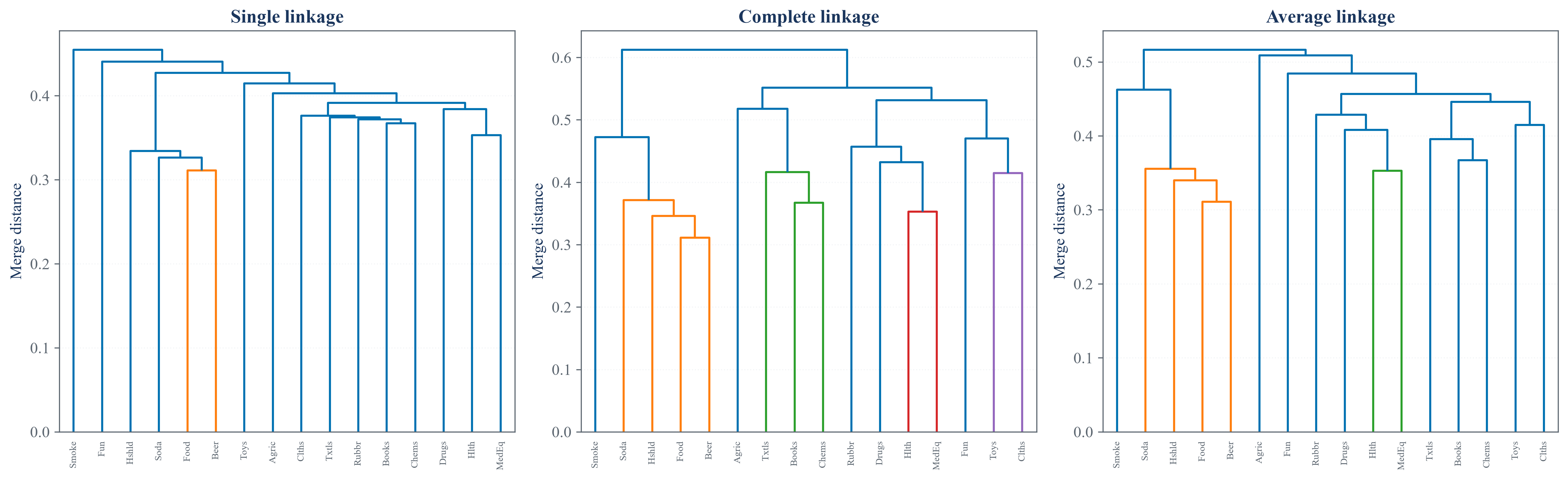
Different linkage rules can join the same correlation distances into different trees, so the tree construction is part of the portfolio design.
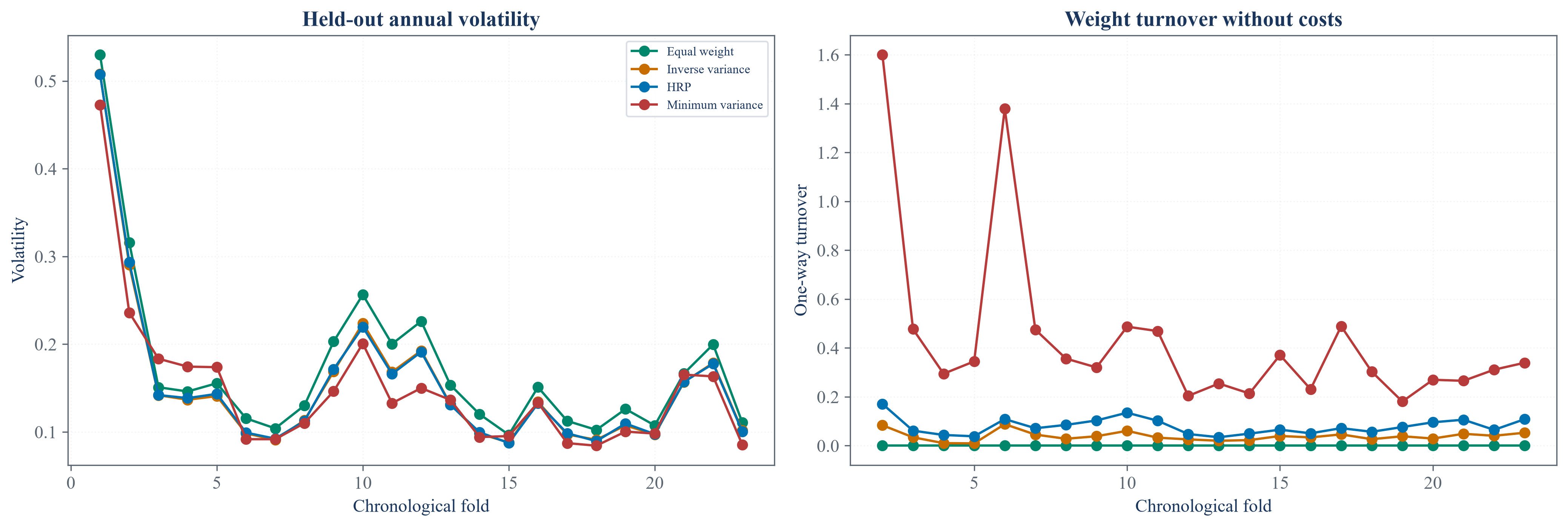
The rolling experiment refits each method using past observations and compares concentration, turnover, and later risk on the same dates.
HRP avoids full covariance inversion, but it still depends on estimated correlations, the linkage rule, and the chosen cluster-risk measure.
Notebooks
| 1. Building an ordered hierarchy from asset distances |
| 2. Allocating risk by recursive bisection |
| 3. Monte Carlo Comparison with Inverse-Covariance Portfolios |