- Published on
Decision-Focused Learning for Robust Portfolio Choice
A prediction with small numerical error can still lead to a poor portfolio decision. Decision-focused learning evaluates predictions through the choices they induce, while robust optimization examines choices across a stated uncertainty set.
The central relation
For a finite feasible list and cost vector , the decision oracle is
contains the supplied feasible decisions, contains their linear costs, and is the first listed decision attaining the smallest cost. The oracle is exact for the convex hull of the supplied vertices.
When prediction errors change portfolio decisions
The SPO+ slice shows the training loss around a decision change. The metric comparison separates prediction error from the realized quality of the selected decisions.
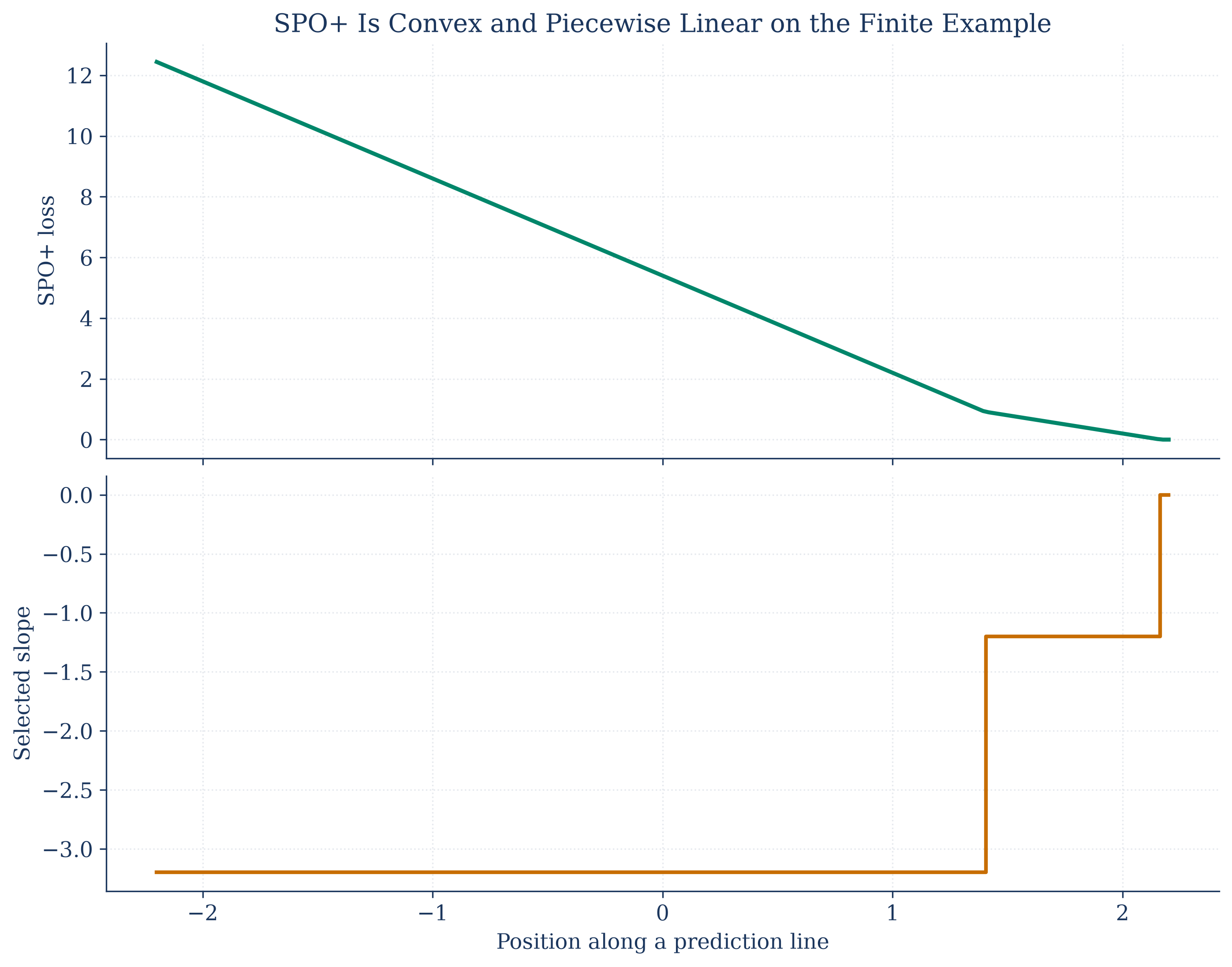
The surrogate responds most strongly where a prediction would change the chosen decision, rather than weighting every prediction error equally.
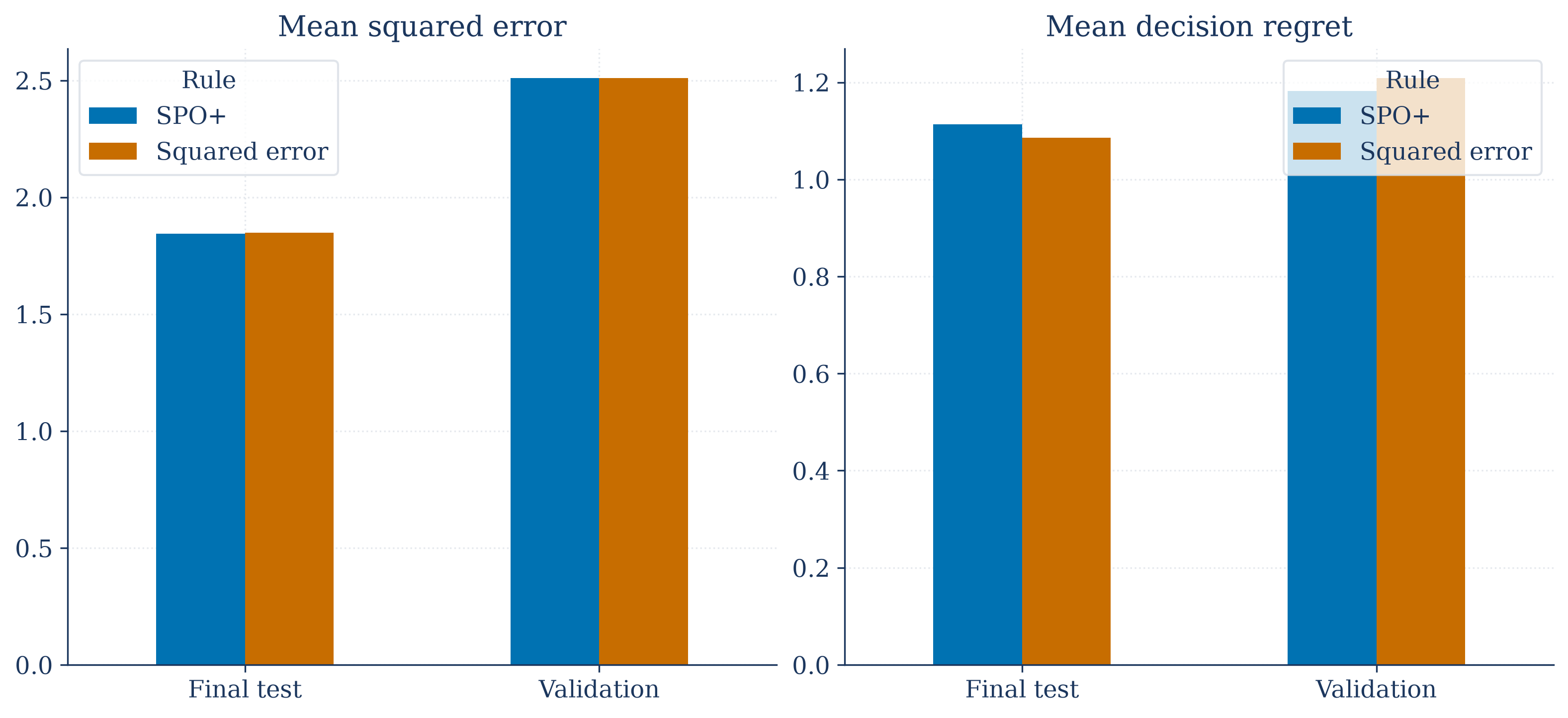
Methods with similar prediction error can produce different decision loss because their errors occur in different directions relative to the portfolio problem.
The decision loss is meaningful only for the declared feasible set, costs, and uncertainty description. Changing those inputs changes the learning target.
Notebooks
| 1. Learning predictions for downstream decisions |
| 2. A Time Ordered Public Return Experiment |
| 3. Robust Mean Variance Choice |