- Published on
Temporal Cross-Validation
A random fold can leak information when financial labels use future prices or overlap in time. The notebooks compare random, ordered, purged, embargoed, and walk-forward designs on the same prediction task.
The central relation
Overlap between two information intervals is recorded by
is the information interval for observation , with start and end . The indicator equals one when observations and share any part of their information intervals.
Keeping future information out of validation
The anatomy figure shows which observations are removed around a test fold. The public comparison reports held-out accuracy across several temporal designs.
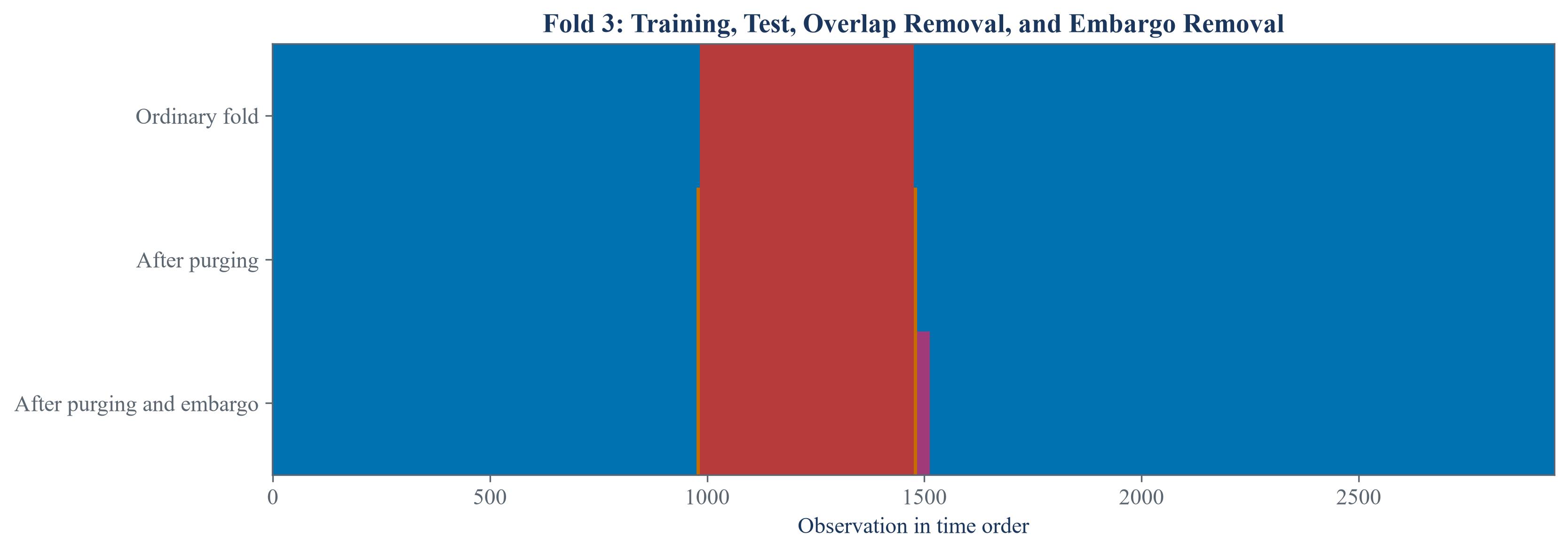
Purging removes training labels whose information overlaps the test period. The embargo removes a short interval immediately after the test fold.
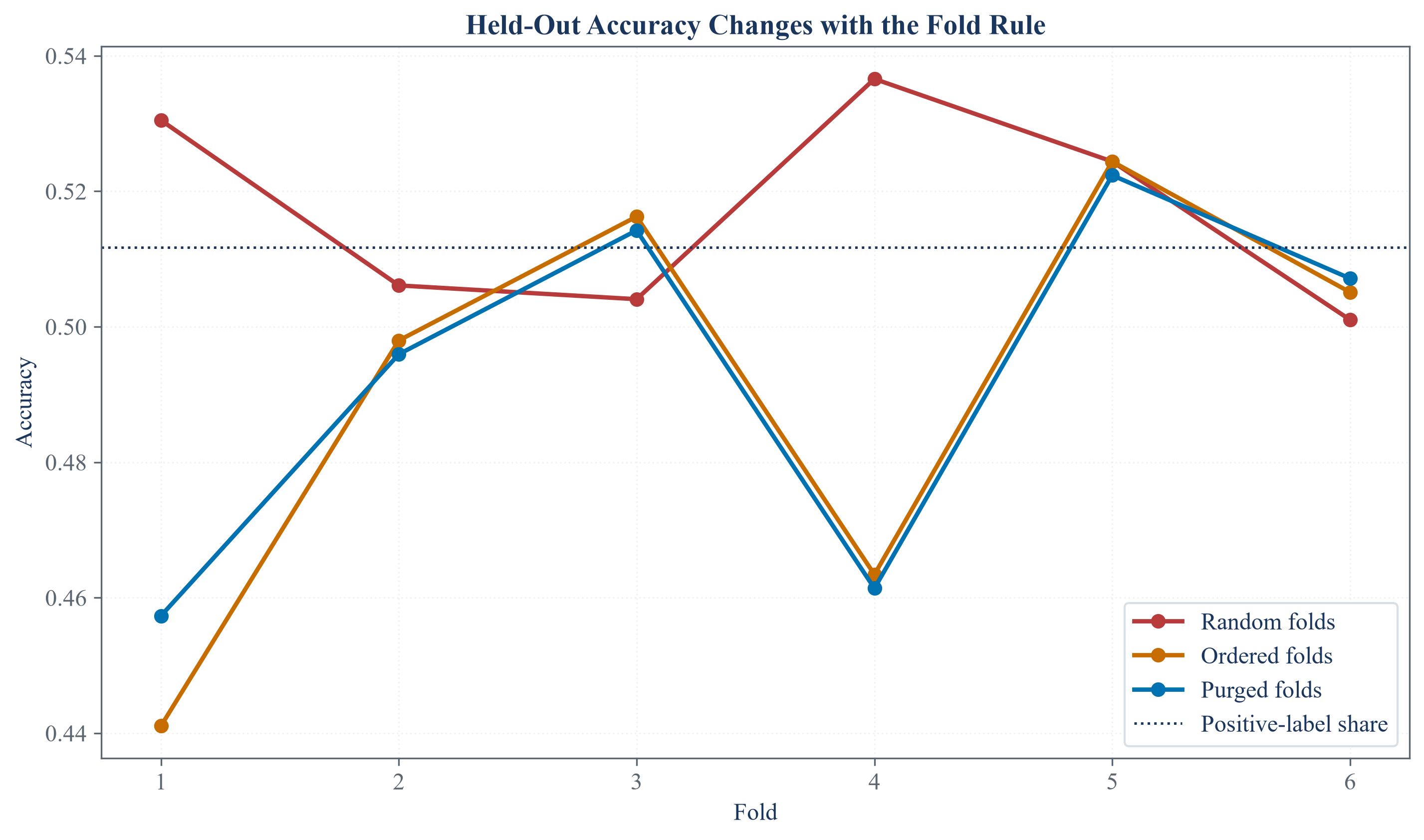
Fold-level results reveal how the validation estimate changes when time order and information overlap are handled explicitly.
Temporal protection reduces a known source of leakage. It does not make later market conditions identical to the evaluation sample.
Notebooks
| 1. Why Random Folds Fail for Overlapping Financial Labels |
| 2. Preventing leakage between training and validation |
| 3. Respecting time order in walk-forward validation |