- Published on
Clustering Predictors for Ensemble Learning
Adding predictors or models helps less when their errors move together. The notebooks begin with a voting calculation, construct clusters from dependence, and test whether those clusters persist across samples.
The central relation
For an odd number of independent voters with accuracy , majority accuracy is
is the number of correct votes, is the ensemble size, and is each voter’s accuracy. The expression gives the independent-error benchmark before dependence is introduced.
How dependence limits ensemble gains
The controlled result measures how shared errors change ensemble accuracy. The public stability plot shows how often predictor pairs remain in the same cluster.
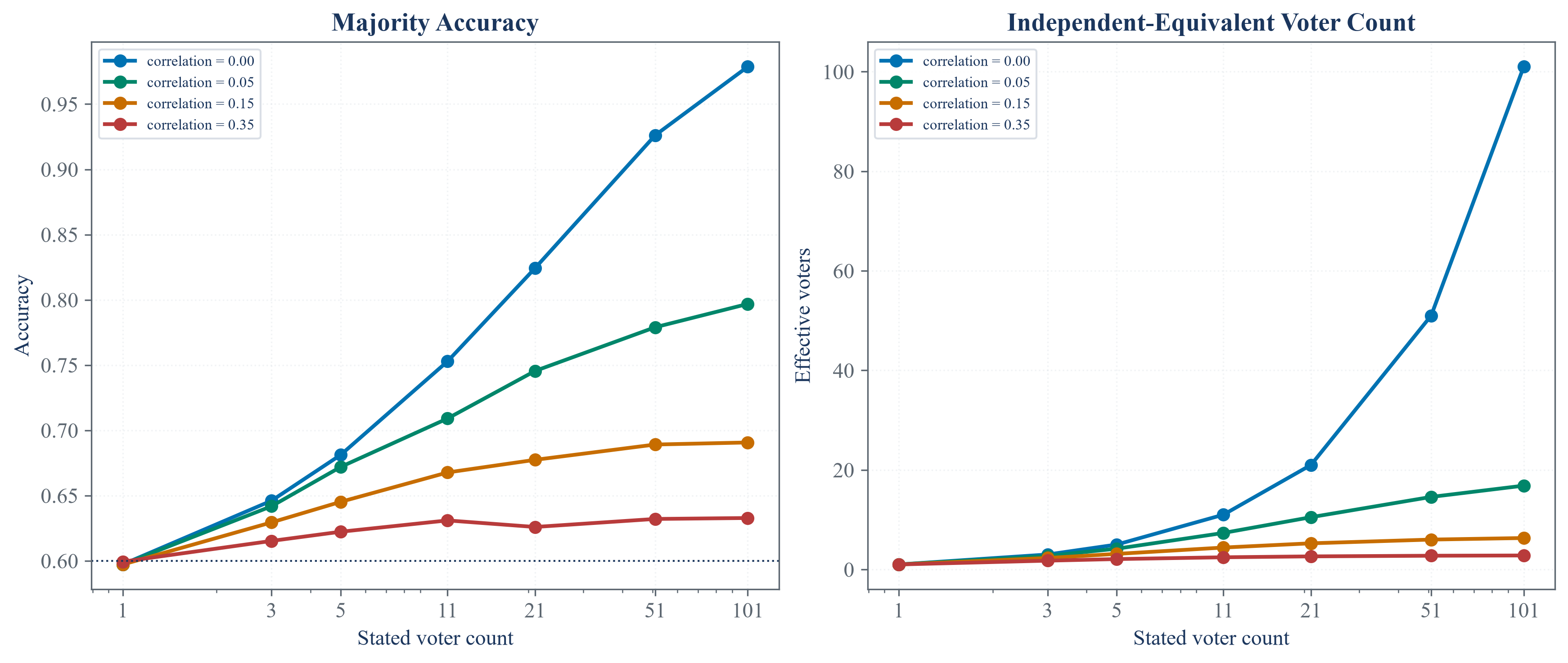
The gain from adding voters falls as their errors become more dependent, even when individual accuracy is unchanged.
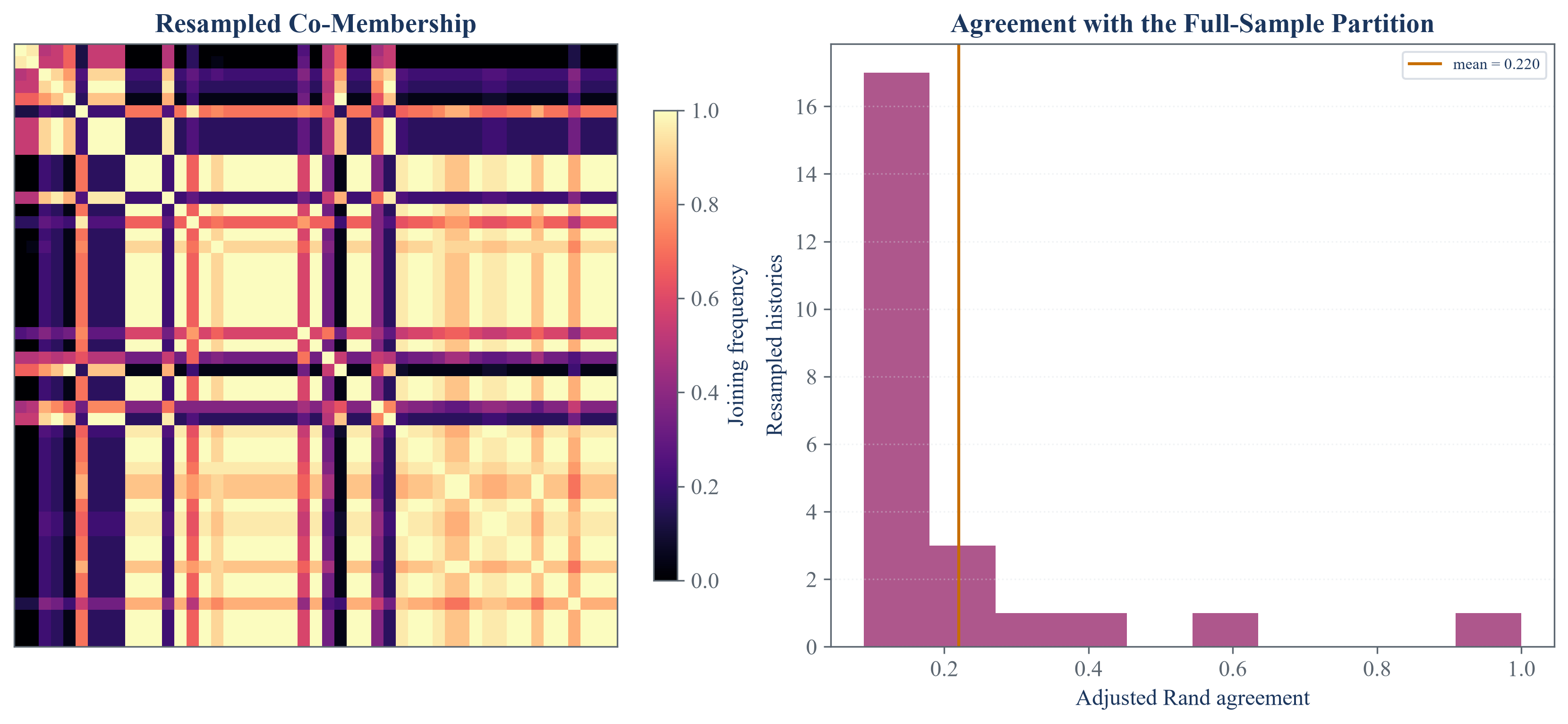
The stability result records how often the public predictor grouping is recovered rather than treating one dendrogram as certain.
A cluster is a summary of measured dependence under a chosen distance and linkage rule. It does not establish that predictors share an economic cause.
Notebooks
| 1. How predictor dependence limits bagging |
| 2. Choosing the number of clusters from correlations |
| 3. Testing nested clusters for stability |