- Published on
Deep Hedging
A hedge must use only current and past information, account for trading costs, and be judged by its terminal cash flow. The notebooks train an adapted policy and compare it with no hedge and a discrete delta hedge.
The central relation
Terminal cash flow is evaluated with the entropic risk measure
includes the option premium, hedge gains, transaction costs, final liquidation, and the payoff owed. The parameter controls how strongly low cash flows affect the risk value.
Testing hedging policies under trading costs
The path figure displays the generated option-price environment used for controlled training. The comparator figure reports terminal risk for the learned and benchmark policies.
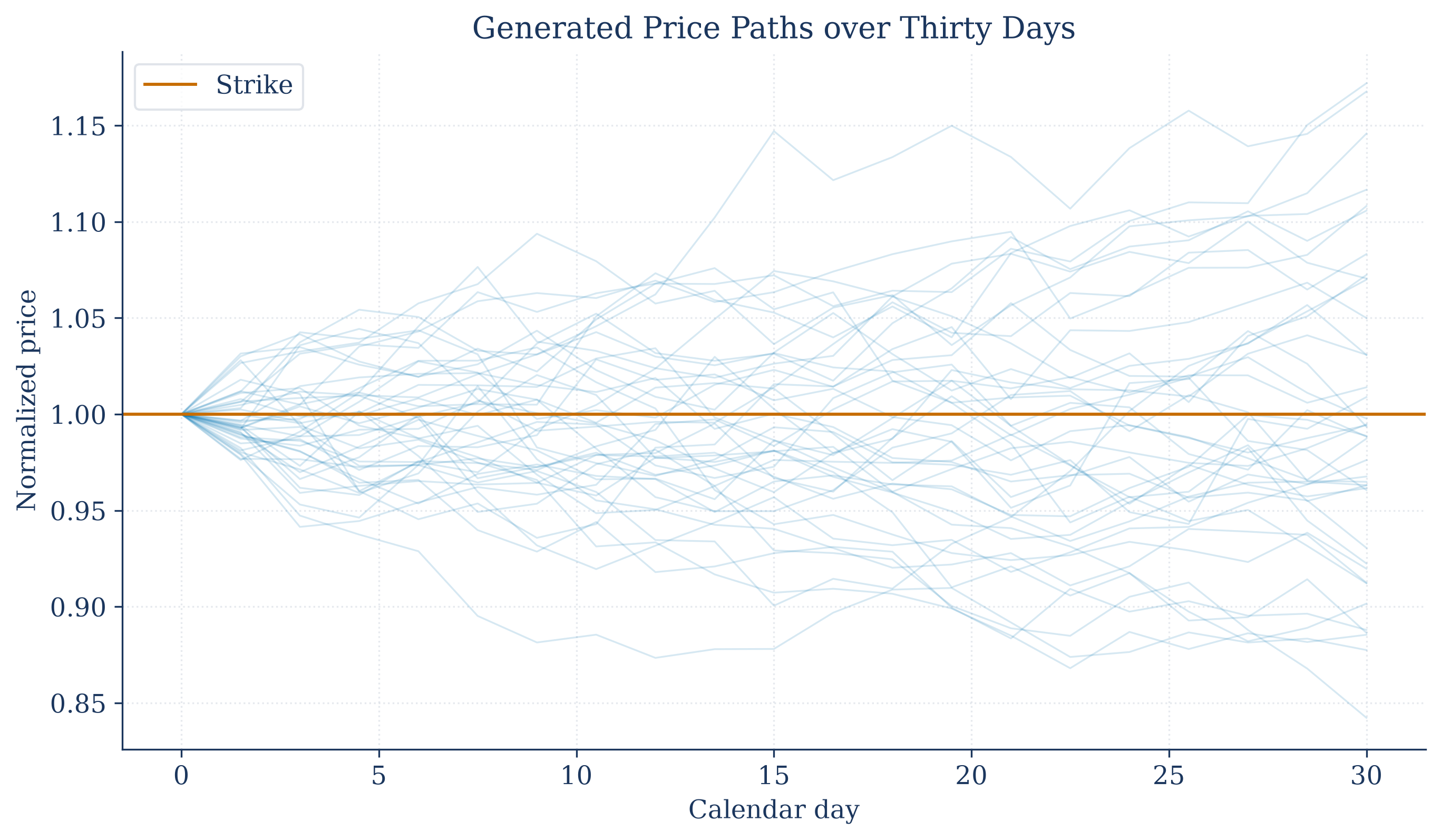
The option paths are generated teaching data with a volatility scale estimated from fixed public observations. Separate samples are used for training and evaluation.
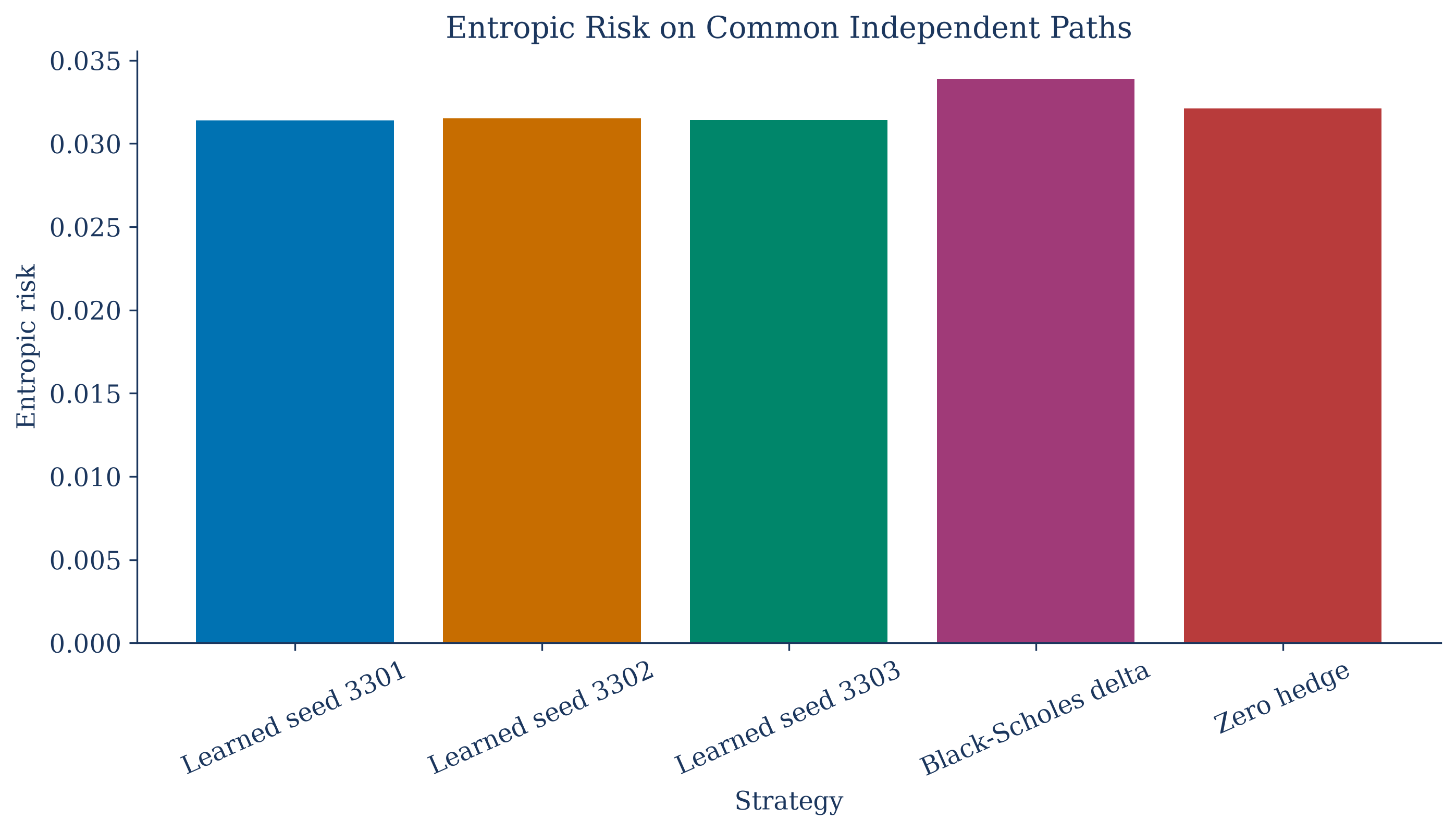
The comparison applies the same payoff, costs, paths, and risk preference to every policy, so differences come from the positions they choose.
The result validates the implemented finite-horizon experiment. It does not establish general market performance or remove model risk from the generated price process.
Notebooks
| 1. Measuring the risk of a self-financing hedge |
| 2. An Adapted Learned Policy |
| 3. Comparing hedge policies across sensitivities |