- Published on
Causal Effects with Network Interference
Many financial and economic actions spread through relationships among units. These notebooks replace the usual no-interference assumption with an exposure rule that records both a unit's own assignment and the assignments of its neighbors.
The central relation
For exposure state , a Horvitz--Thompson mean is
is the number of units, is the exposure state of unit , is its observed outcome, and is the probability that it receives exposure . The indicator selects units in that exposure state. The contrast compares two exposure means.
Estimating spillovers under unequal exposure
The topology figure turns public market associations into an illustrative network. The repeated assignment experiment then checks the weighted estimator against a known contrast under the declared exposure rule.
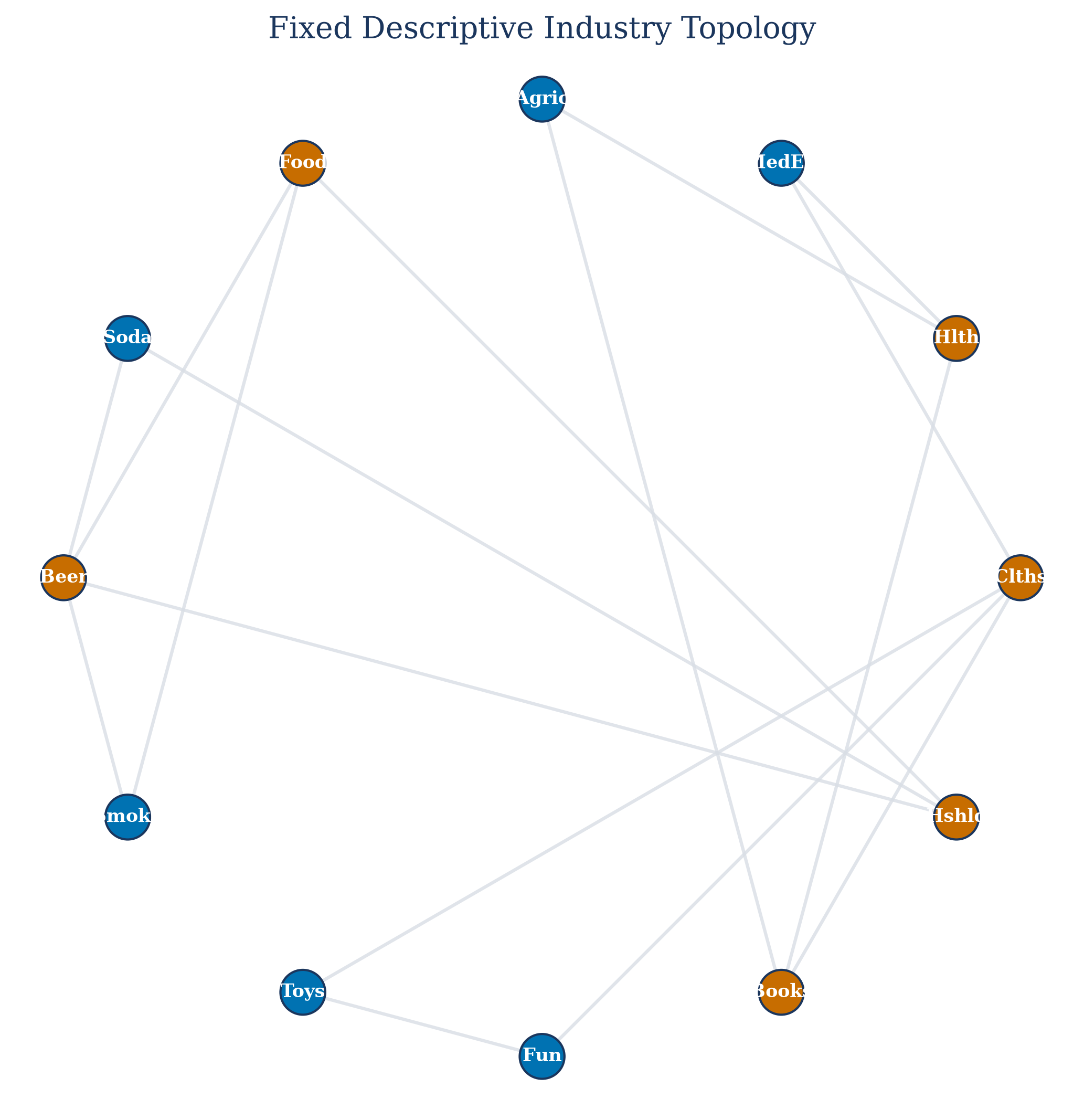
The network supplies a visible neighborhood structure for the experiment. Its links describe selected public associations and are not presented as causal relations.
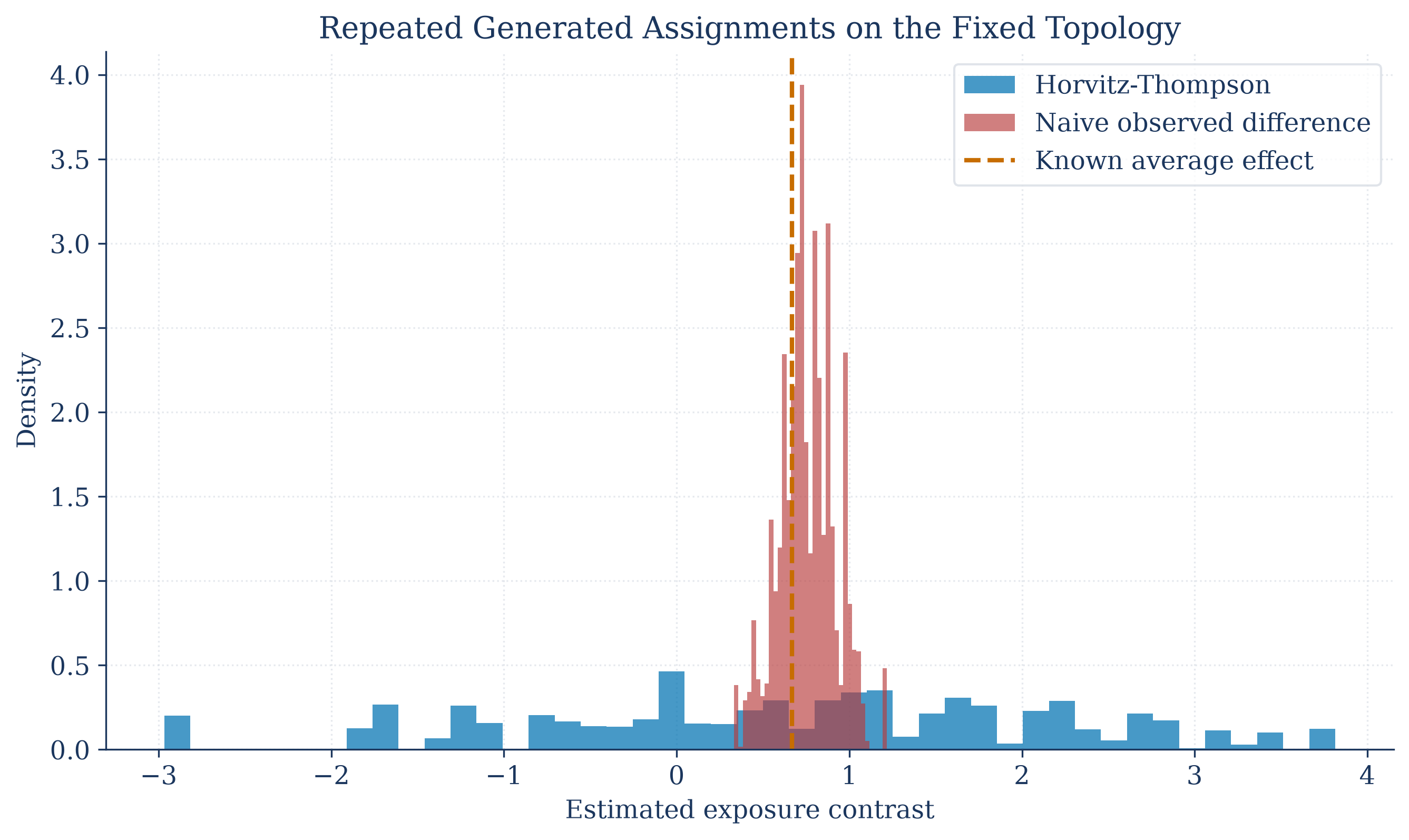
Repeated assignments show the sampling variation created by unequal exposure probabilities and the correction supplied by inverse-probability weighting.
The exposure rule and assignment mechanism are part of the causal question. A descriptive correlation network alone does not identify spillover effects.
Notebooks
| 1. Mapping assignments to network exposure |
| 2. Horvitz-Thompson Exposure Contrasts |
| 3. Where interference estimates remain credible |